What a God-Centered 12-Step Program Looks Like in a House
For people who want a faith they can name out loud, here is how a God-centered 12-step program works when it lives in a shared home.
October 14, 2026 · 4 min read
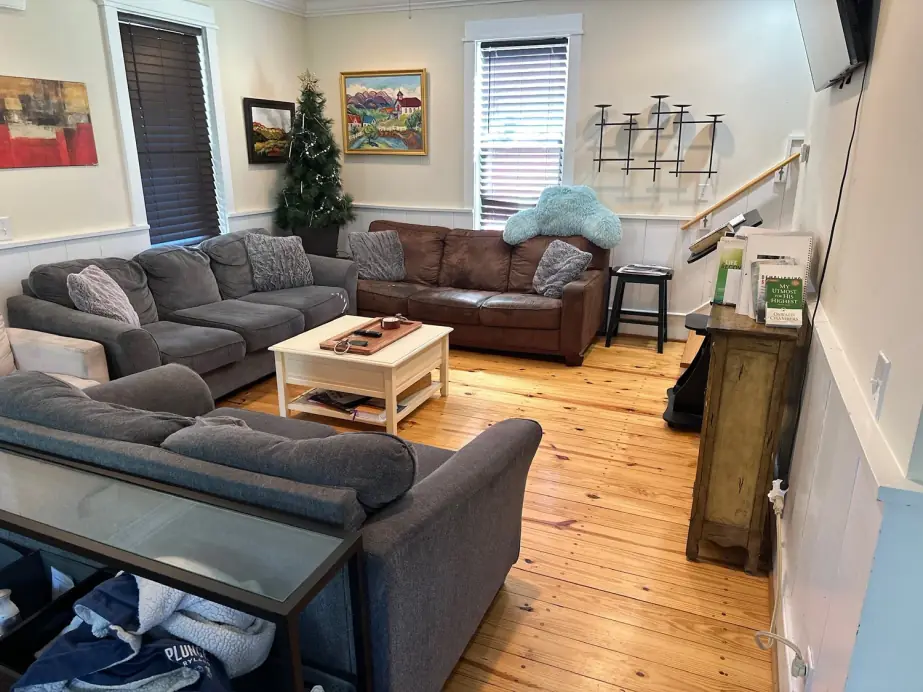
Plenty of people have heard that recovery is “spiritual, not religious,” and plenty have found that phrase useful. Others want something more specific, a faith they can name out loud. Still Worthy was built for that second group.
It describes itself as a recovery residence dedicated to helping people overcome addiction and develop a relationship with Christ. So what does a God-centered 12-step program look like inside a house? Here is what Still Worthy shares about itself, along with some general background on the steps.
The 12 steps, lived in a shared home
The 12 steps are a set of principles that many people use to stay sober. They involve honesty about the problem, reliance on something greater than yourself, making amends, and helping others. They were never meant to be walked alone, which is why fellowship is built into them.
Still Worthy lists God-Centered 12 Steps as the first part of its foundation, beside fitness and wellness, personal growth, spiritual growth, biblical teachings, and fellowship and community. The appeal of working the steps in a shared home is easy to see. You're surrounded by people who are doing the same work, so you don't have to explain yourself from scratch every time.
The steps ask a lot of a person, and they ask it in the open. A house full of people who understand that can make the asking feel less like a verdict and more like an invitation.
Rest for people who are tired
Among the biblical teachings Still Worthy shares is Matthew 11:28: “Come to me, all who are tired from carrying heavy loads, and I will give you rest.”
Anyone who has lived in active addiction knows what a heavy load is. The lying, the hiding, the constant arithmetic of how much is left and how to get more. It is exhausting. For many people of faith, that verse isn't decoration. It is an invitation they hear as meant for them.
Cofounder Uros Pejanovic is described on the Still Worthy site as deeply rooted in his faith in Yeshua and as living by the principle that life is something to be given in service to others. That idea of service runs through the 12 steps too, and it is part of why a faith-based house and a 12-step program fit together so naturally.
Spirituality, Purpose, Community
Still Worthy organizes its program around three pillars. Spirituality means building a relationship with Christ. Purpose means living a purpose-driven life. Community means developing positive fellowship.
The Purpose pillar says something worth slowing down for: “We are not focused on helping our fellow addicts and alcoholics regain what they lost in active addiction, but rather gain something greater than they have known.” Many people think of recovery as getting back to normal. This one reaches for more than that.
The Community pillar puts it most simply: “Being alone never feels right; sometimes it feels good, but it never feels right.” That sentence is honest about why isolation is so tempting and why it doesn't work. Still Worthy says it wants to foster meaningful, life-long friendships built on empathy and understanding.
Faith without pressure
A faith-based program raises fair questions. What if I'm not sure what I believe? What if a church hurt me once? Those are reasonable things to wonder, and they are worth asking the team directly before you apply.
What Still Worthy states plainly is that its approach is Christian. It isn't hiding that. Honesty is one of its core values, along with compassion, togetherness, faith, humility, and self-sacrifice, so it is reasonable to ask for a straight answer about what faith looks like day to day.
Faith in a recovery house is also not a performance. The point of the pillars is to give a person something to lean on while their own strength is thin, and to give them people to lean on beside it. Nobody can do that for you, but nobody has to watch you try it alone.
And if you're a family member reading this because someone you love is searching for a place that takes faith seriously, this may be exactly the kind of fit you hoped to find. Compassion, as one line on the Still Worthy site has it, is the basis of morality.
Starting the conversation
The first step isn't a decision about doctrine. It is a phone call or a form. Applying is described as easy: fill out the online application, and a member of the team will reach out to discuss the next steps and answer any questions you may have.
You can reach Still Worthy at (843) 566-5788 or up@stillworthy.org. Bring your doubts along with your questions. Both are part of an honest start.
Still Worthy, (843) 566-5788
Call (843) 566-5788More articles
What a Recovery Residence Is, and What It Is Not
A recovery residence is a home first, and knowing the difference between a home and a clinic can save you a lot of confusion.
How to Talk to Someone You Love About Getting Help
There is no perfect script, but there are ways to talk that make it easier to be heard, and a clear next step if the answer is yes.